Timed entry ticketing that caps each arrival window
Sell admission by time slot instead of by day. Every window carries its own capacity, so 10:30 can sell out while 11:00 keeps selling — and the window is printed on the ticket your team scans at the door.
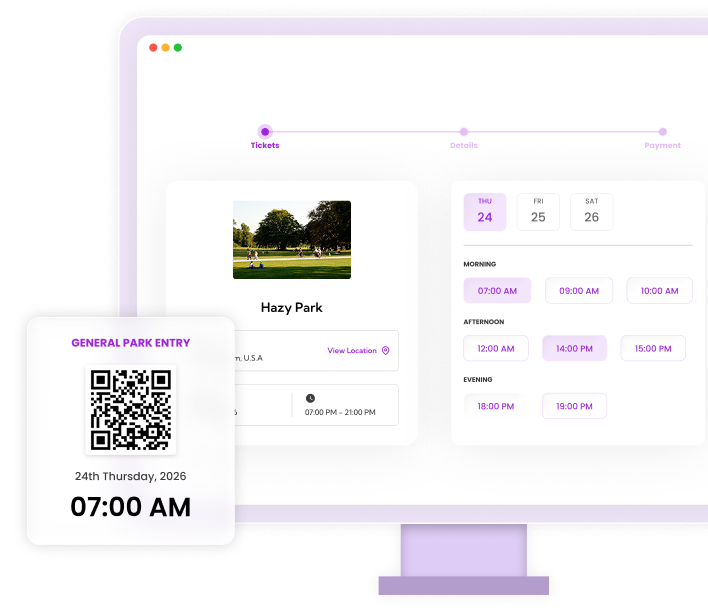
Timed entry ticketing sells a place in an arrival window rather than a place in a day. The buyer picks a date, then a time, then their tickets, and the number you set on that window is the number that can be sold for it. When it reaches zero the window closes and the rest of the day carries on selling.
That is the whole mechanism, and it is the reason venues adopt it: the constraint being managed is how many people arrive at once, not how many arrive in total. If you want the design detail — what to put on the slot picker, the confirmation and the ticket itself — the five screens a timed-entry buyer sees covers it screen by screen.
How a timed entry schedule is built
You describe the pattern once rather than entering each occurrence. Time-slot event layouts start on Professional.
1. Describe the schedule, not the slots
Give the dates you are open and the length of an arrival window — every 15, 30, 45 or 60 minutes — and the schedule expands into individual windows for you. A repeating pattern is entered once rather than as a list of occurrences.
2. Put a capacity on each window
Each window carries its own number, and each ticket type within it carries its own. That number is what the buyer is drawing down when they pick a time, and it is what closes the window when it reaches zero.
3. Price the ticket types
Adult, child, concession, member — the same ticket types you would sell for general admission, except each purchase now also carries an arrival window. Prices can differ between ticket types on the same window.
4. Publish and sell
The event goes out with a time-slot layout: the buyer picks a date, then a time, then tickets. You can put that on a hosted event page or embed it in your own site, and either way the arrival window is printed on the ticket that arrives by email.
Timed entry or general admission
Both are ordinary ticket sales. They differ in where the capacity sits, and everything else follows from that.
| General admission | Timed entry | |
|---|---|---|
| What the buyer chooses | A date | A date and an arrival window |
| Where the capacity sits | One number for the whole day | A number per window |
| How a sell-out reads | The day is gone | That window is gone; the next one is still open |
| Arrival pattern | Whenever people turn up, usually the first hour | Spread across the windows you published |
| What the door is checking | That the ticket is valid | That the ticket is valid and this is its window |
| When it is the wrong choice | When the constraint is how many people are inside at once | When arrival time genuinely does not matter |
Who sells by arrival window
The bottleneck is different in each of these, and the bottleneck is what decides the shape of the schedule.
Museums, galleries and historic sites
Because the limit is how many people can stand in a room at once, and it is usually written into a fire certificate rather than chosen.
Guided tours and walking tours
Because one guide takes one party, the party has a maximum, and the next departure cannot start until the route clears.
Attractions with a session length
Because climbing walls, trampoline parks and soft play sell a fixed block of time with a hard changeover, so capacity is per session.
Workshops, classes and courses
Because the same room runs several sittings a day, and a package or pass has to work across all of them.
Farms, pick-your-own and seasonal events
Because weekend demand collapses into about three hours and the car park is usually the real bottleneck.
Which plans include timed entry
- Timed entry tickets and passes — from Professional. The free plan sells general admission only.
- Time-slot event layouts, the date-then-time picker the buyer moves through — from Professional.
- Pricing and capacity per ticket type — every plan, Free included. It is what the per-window number draws down.
- PDF tickets with QR codes — from Professional, read by the mobile scan app from Professional.
- Check-in limit per ticket, so an already-scanned ticket is refused rather than accepted twice — from Business, along with waitlists from Business.
- Interactive seating charts — from Business, if a buyer needs a specific seat as well as a window. Timed entry does not require them.
There is no per-ticket fee on any plan. Full plan-by-plan detail is on the pricing page.
What this does not do
The boundaries, so they are found here rather than on a wet Saturday.
Capacity is per window, never pooled across the day
You give each arrival window a number, and each ticket type its own. There is no single daily figure that every window draws down from. If your real constraint is the building rather than the window — 400 people inside at any one time, however they arrived — you reach it by setting window capacities that add up to it, not by entering it once. Windows do not borrow unsold capacity from each other.
A window is not a seat
Timed entry controls how many people arrive in a period. It does not assign anyone a specific place. If the buyer needs to choose an actual seat, that is a seating chart, and it is a separate feature on a higher tier.
Enforcing one entry per ticket is a higher tier
Selling by window works from the moment timed entry is switched on. Refusing a ticket that has already been scanned — and the early check-in window that lets someone in a few minutes before their slot — are separate controls that start further up the plan list.
Nobody is moved between windows for you
If a visitor asks to come at 11:00 instead of 10:30, that is a change you make to their order. Ticket Spot will not rebook anyone automatically.
Frequently asked questions
Timed entry ticketing sells admission for a specific arrival window rather than for a whole day. The buyer picks a date and then a time — 10:00, 10:30, 11:00 — and each window has its own capacity, so it can sell out while the windows around it are still open. The point is to control how many people arrive at once instead of how many arrive in total.
The ticket carries its arrival window, and it is scanned like any other QR-coded ticket. Your staff can see which window the ticket was bought for as they scan it, so someone who arrives two hours early is a decision you make rather than a surprise you find out about later.
Yes, and that is the mechanism rather than an option. Every arrival window carries its own number and each ticket type within the window carries its own. When a window reaches zero it stops selling and the rest of the day carries on.
Yes. You describe the pattern once — every 30 minutes from 10:00 to 16:00, on these dates — and each occurrence becomes its own window with its own capacity, so each departure sells and sells out independently.
Timed-entry tickets and passes, and the time-slot event layout that goes with them, start on the Professional plan. The free plan sells free general-admission tickets and does not include them. Refusing an already-scanned ticket and the early check-in window start on Business. There is no per-ticket fee on any plan.
No, and they solve different problems. Timed entry limits how many people arrive in a window without saying where they stand; reserved seating gives each buyer a specific seat. Seating charts are a separate feature starting on Business. Plenty of venues use timed entry precisely because they do not want to allocate seats.